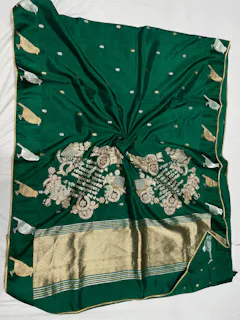
This royal blue Banarasi silk saree is a handloom masterpiece featuring gold and silver zari woven Pichwai Aghanya (cow) motifs across the body woven with pure Puna silk. The saree is accentuated with a silver and gold zari-striped border on a satin base and complemented by an ethnic brocade pallu. It comes with a matching unstitched blouse piece for custom styling.
Key Features: • Handloom Puna Silk Banarasi Saree • Color: Royal Blue • Gold and Silver Zari Woven Pichwai Aghanya Motifs • Satin Base Border with Zari Stripes and Ethnic Brocade Pallu • Saree Length: 5.5 meters • Blouse Material: ±90 cm • Width: ±44 inches
Delivery within 20-25 business days. For urgent delivery, please contact us.
For additional services like blouse stitching customization, kindly contact our team at +91 7705012088. Note: Availing these services makes the product ineligible for exchange or refund.
Perfect for: Weddings, cultural gatherings, and festive occasions.
Care Instructions: Dry clean only.
Please Note: Actual color may slightly vary from the image due to photography and lighting conditions.
Styling Tips: Pair this saree with light gold jewelry and a potli bag for a traditional wedding look.
SKU: BSS-159F
Let customers speak for us
from 293 reviews
jasmine
pink silk saree
Very light and comfortable saree. Looks graceful when worn. Happy with the purchase.
Reddish Pink Shaded Banarasi Organza Silk Saree
06/12/2026
Manya
pink lehenga
Really pretty in person. Fabric feels rich. Good for functions and weddings.
Pink Raw Silk Kalidar Lehenga Inspired by Bollywood
06/12/2026
jasleen
black lehenga
Bought for bridesmaids. Looks elegant and wearable again later. Everyone liked it.
Black Banarasi Raw Silk Kalidar Bridesmaid Lehenga
06/12/2026
Dimple
green banarsi silk dupatta
Nice dupatta. Bird motifs are beautiful. Easy to pair with outfits.
Green Banarasi Silk Dupatta with Bird Motifs
06/12/2026
disha
pink banrasi silk dupatta
Used it with a plain suit and it upgraded the whole look. Very rich color.
Magenta Pink Banarasi Silk Dupatta with Aghanya Pichwai Motifs
06/12/2026
Gargi
red salwar suit
Silk quality is really good. Dupatta design is unique. Feels premium.
Deep Red Katan Silk Salwar Suit with Bird Motif Dupatta
06/12/2026
anju
red silk suit set
Dupatta is the best part. Looks festive and rich. Overall good outfit for occasions.
Red dupion Silk Suit Set with Gayatri Mantra Dupatta
06/12/2026
ashu
Sky blue saree
Color is very refreshing. Peacock work is subtle and nice. Comfortable for long wear.
Aqua Blue Georgette Saree with Peacock Floral Work
06/12/2026
tanu
black organza saree
Loved the half-and-half design. Looks very trendy. Got compliments when I wore it.
Black Half n Half Organza Silk Saree with Applique Work
06/12/2026
neha
pink organza saree
Gift from my sister. Really pretty in person. Very light and perfect for summer events.
Pink Organza Silk Saree with Gota Patti Floral Work
06/12/2026
simar
black crushed saree
Wasn’t sure at first but glad I ordered it. Looks stylish and modern. Drapes really well.
Black Crushed Tissue Silk Saree with Gold and Silver Stripes
06/12/2026
simran
red saree
Blouse is the highlight. Radha Krishna work is very detailed. Got a lot of compliments. Packaging was good too.
Nita Ambani Inspired Red Patola Saree with Radha-Krishna Embellished Blouse
06/12/2026
Kanchan
white and red organza silk saree
Looks exactly like the pictures. Light and elegant. Cutwork is neat. Good for festive wear.
White and Red Organza Silk Saree with Applique & Cutwork
06/12/2026
Kiran
banarasi silk saree
Loved the mix of motifs and bandhani print. Looks different from regular sarees. Fabric is nice and soft.
Banarasi Silk Black Saree with Pakshi Motif and Tie & Dye Bandhani Print
06/12/2026
Prachi
black soft silk
Very comfortable fabric. Not heavy at all. Easy to drape and wear for long hours. Good purchase.
Yes, this saree is one of the most thematically appropriate drapes for Janmashtami, Govardhan Puja, and Krishna-themed family events, because the Pichwai aghanya cow motifs directly reference Lord Krishna's bond with his sacred cows. The royal blue base also aligns with Krishna's iconographic colour, making the saree feel intentionally curated for the occasion rather than incidentally festive. It is frequently gifted within families ahead of major Krishna festivals for this reason.
A Pichwai-motif Banarasi saree carries devotional folk imagery, primarily cows and Krishna iconography, woven from the Rajasthani Pichwai tradition into the Banaras handloom vocabulary. A typical floral or paisley Banarasi, by contrast, uses Mughal-era courtly motifs like butis, kairi, and meandering vines. The Pichwai saree reads as more narrative, more spiritual, and more conversation-starting, which is why it is preferred for cultural events, religious functions, and family heirloom gifting.
Puna silk has a soft, fluid hand that makes it easier to pleat and drape than the heavier katan, while still carrying more structure than the lightest chiniya variants. Compared to tanchoi, which has a denser woven surface, puna is more pliable around the waist and pallu, which is why first-time saree wearers often manage puna silk sarees more comfortably across long events. It is a balanced silk that fits between heritage weight and modern manageability.
Yes, this saree is one of the strongest picks for women who value the story behind their textile over surface trend. Pichwai art originates in Nathdwara, Rajasthan, and depicts scenes of Lord Krishna and his sacred cows, so wearing this saree carries a narrative thread that conversational and editorial contexts respond to. It is often recommended for collectors, gifting between generations, and women curating a wardrobe of meaningful occasion sarees.
Yes, this royal blue puna silk saree is especially well suited for religious functions, temple weddings, Janmashtami celebrations, Krishna-themed milestone events, and Nathdwara pilgrimage gatherings, because the Pichwai aghanya cow motifs reference one of India's most sacred devotional art traditions. The saree carries cultural and spiritual weight beyond its visual beauty, making it a preferred recommendation for women who want their occasion wear to reflect personal devotion alongside celebration.
Yes, the dense Pichwai motifs and royal blue base carry enough visual weight that stylists frequently recommend pairing this saree with restrained jewellery, often just a pair of statement temple jhumkas, a simple gold or polki choker, and a single stack of bangles. Over-styling with heavy maang tikkas, layered necklaces, and full-arm bangles risks competing with the saree's narrative motifs, which is why minimal jewellery is the preferred approach with this drape.
Puna silk is a traditional Banaras silk variant prized for its soft drape, lustrous finish, and ability to carry intricate motif work without becoming stiff. The saree is hand-woven on a Banaras pit loom, with the Pichwai cow motifs and zari detailing introduced through coordinated pattern-frame lifts during weaving rather than printed or embroidered on top. This makes the design integral to the fabric and durable across generations of wear and storage.
Pichwai is a devotional folk-art tradition from Nathdwara in Rajasthan, where cloth paintings depict Lord Krishna and his beloved cows, called aghanya in Sanskrit, meaning those who must not be harmed. Translating this sacred art onto a Banaras handloom saree honours both the Pichwai tradition and Banaras's role as India's premier silk-weaving city. The motifs carry blessings of abundance, devotion, and protection, which adds emotional weight to the saree.
The saree is best suited for Krishna Janmashtami, Govardhan Puja, Nathdwara visits, temple weddings, daytime traditional weddings, Diwali pujas, family religious gatherings, intimate engagement ceremonies in traditional households, and cultural events such as classical dance performances or heritage exhibitions. Its royal blue tone makes it appropriate for both daytime and evening contexts, and the devotional motifs lend it gravitas at events where colour alone would feel insufficient.
This saree works particularly well during the late-monsoon-to-winter window from August through February, which covers Janmashtami, Navratri, Diwali, the major Indian wedding season, and Republic Day cultural events. The puna silk's medium body provides comfort across both warm late-monsoon evenings and cooler winter afternoons. In summer months, it is best reserved for AC indoor temple weddings or evening cultural events rather than outdoor daytime functions.
Yes, royal blue is one of the strongest saree tones for indoor and evening photography because it picks up warm tungsten light gracefully, contrasts beautifully against marble, candlelight, and traditional wood interiors, and lets gold zari work read sharper than on warmer base colours. For temple weddings, indoor pujas, and reception venues with mixed lighting, this saree photographs as both rich and restrained, which is why it is favoured for heavily documented family functions.
Karuna Choudhary
Pink Banarasi Saree
This is such a gorgeous banarasi saree. When I first saw it, I loved the color palette. It is a perfect choice for a bride to be!! Or someone is who is newly married.
Gorgeous color, pure fabric..a statement piece.
Reddish Pink Shaded Banarasi Organza Silk Saree
Dr Suman
Great choice ♥️
I brought the Gayatri mantra saree in bottle green color. Had a good experience with the team who made the experience hassle free.
Nita Ambani Inspired Red Saree with Gayatri Mantra
Anamika
Something beautiful and special
I am very glad to have bought this extraordinary dupatta. The design is unique and the quality of material the best.
Steel Blue Linen Dupatta with Digital Printed Pichwai Motifs
Khushboo
The suit was even prettier in person..loved the fabric and the colour.🩷👍
Red Salwar Suit Set with Intricate Zari Work And Dupatta
Sunayana Sharma
Absolutely worth it
I felt like a queen in this gorgeous saree ❤️✨ You made my Karwa Chauth festival even more special. The quality of the fabric is really good and the Gayatri Mantra embroidery is done so beautifully. I truly recommend Chinaya Banaras and loved being a part of the Chinaya family 💫
Nita Ambani Inspired Red Saree with Gayatri Mantra