Wedding Reception Sarees


Recently viewed
Handloom Banarasi Silk Sarees from Varanasi
Handloom sarees are woven by hand on a manual loom. Handloom Banarasi silk sarees add pure silk and real zari from Varanasi. Chinaya Banaras has four ready-to-ship handloom Banarasi sarees, listed below.
allu, and the selvage. Three quick checks separate the handloom from powerloom.
What Are Handloom Sarees?
Handloom sarees are woven on a loom run by the weaver’s hands and feet, with no electric power.
India has many handloom traditions. Each region has its own weave, motif, and fibre. The weaver sets the warp threads. Then the weft is passed through by hand. The weaver controls the pattern thread by thread. The work is slow. Small irregularities stay in the cloth. They show that a person made it.
What Makes Handloom Banarasi Sarees Different?
Handloom Banarasi sarees come from Varanasi and carry brocade work in gold and silver zari.
Weavers in Varanasi have worked this craft since the Mughal era. Motifs such as Kalga, Bel, and Jaal come from Mughal art. Authentic Banarasi weaving also carries a Geographical Indication tag. It covers six Uttar Pradesh districts: Varanasi, Jaunpur, Bhadohi, Mirzapur, Chandauli, and Azamgarh. One saree can take 15 days to 6 months to finish. Complex designs take longer.
Which Fabrics Do Weavers Use?
Katan, Satin, Tussar, and Organza are the main fabrics used for handloom Banarasi silk sarees.
- Katan: twisted pure silk threads. Strong, shiny, and long lasting.
- Satin: a smooth, glossy surface with a heavier drape.
- Tussar: a textured weave with a golden tone.
- Organza: sheer and light, often with zari work.
How Are Handloom Banarasi Silk Sarees Made?
Handloom Banarasi silk sarees go through five steps, from raw yarn to finished brocade.
- Yarn preparation: pure silk threads are twisted and dyed.
- Warp setting: the weaver strings the lengthwise threads on the loom.
- Pattern setting: hundreds of punch cards set the design.
- Weaving: the weft passes by hand. Zari wire forms the motifs.
- Finishing: the saree is checked, trimmed, and cleaned.
How to Tell Handloom From Machine-Made
Check the back, the p
| Check | Handloom | Powerloom |
| Reverse side | Floats visible in the warp and weft | Smooth, uniform back |
| Pallu and border | Clean finish on the reverse | Loose hanging threads |
| Selvage | Pin marks from the loom | No pin marks |
| Design | Small irregularities | Perfect uniformity |
Also ask for a Silk Mark certificate. It confirms that the silk is pure.
Four Ready-to-Ship Handloom Banarasi Sarees at Chinaya Banaras
Chinaya Banaras lists these four handloom Banarasi sarees as ready to ship, in lilac, wine, black, and red.
Lilac Kadhwa Handloom Katan Silk Banarasi Saree with Meenakari Border: Kadhwa weaving with silver zari motifs and a Meenakari border.
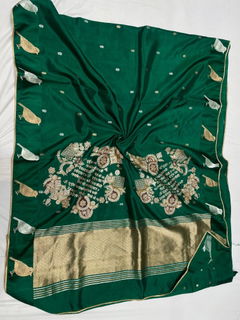
Wine Handloom Banarasi Satin Silk Saree with Silver Zari Work: silver zari on a wine satin silk base.
Black Handloom Banarasi Saree with Chand Buta Work: Chand Buta motifs on a black base.
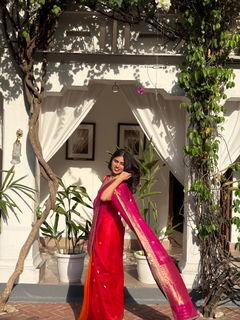
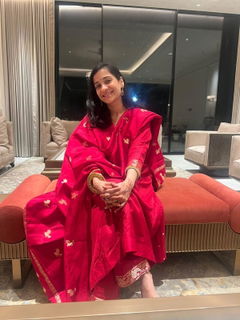
Bright Red Handloom Banarasi Silk Saree: a classic red saree for weddings and festivals.
How to Care for a Handloom Banarasi Silk Saree
Dry clean only. Store it in muslin. Keep perfume away.
- Dry clean: do not wash it at home.
- Store dry: wrap it in muslin, away from sunlight.
- Skip perfume: spray before you dress. Never on the zari.
- Iron low: use low heat on the reverse side.
Why Handloom Still Matters
Buying a handloom saree keeps weavers working and keeps old techniques alive.
Every handloom Banarasi saree supports a weaving family in Varanasi. It is also a piece you can wear for years and pass on. Chinaya Banaras lists the four sarees above for anyone ready to buy.