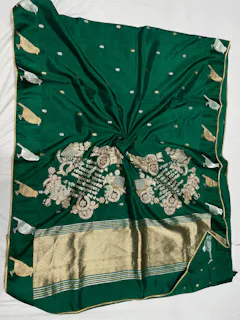
This Banarasi dupatta is made from smooth, lustrous Katan silk fabric. The vibrant green shade features an intricate gold zari woven Pichwai brocade jaal throughout, complemented by a beautifully detailed border and pallu.
Key Features: • Material: Banarasi Katan Silk • Color: Green • Gold zari woven Pichwai brocade jaal all over • Intricate border and pallu • Dupatta Length: ±2.5 meters
Deliver within 30-35 business days. For urgent delivery, Please contact us.
Perfect for: Weddings, Festival, or Special occasions.
Care Instructions: Dry clean only.
Please Note: Actual color may slightly vary from the image.
Tips: Pair this green Banarasi Katan silk dupatta with a matching green kurta for a cohesive look or choose a contrasting gold kurta for a Traditional Look.
SKU: CDP-281
Let customers speak for us
from 293 reviews
jasmine
pink silk saree
Very light and comfortable saree. Looks graceful when worn. Happy with the purchase.
Reddish Pink Shaded Banarasi Organza Silk Saree
06/12/2026
Manya
pink lehenga
Really pretty in person. Fabric feels rich. Good for functions and weddings.
Pink Raw Silk Kalidar Lehenga Inspired by Bollywood
06/12/2026
jasleen
black lehenga
Bought for bridesmaids. Looks elegant and wearable again later. Everyone liked it.
Black Banarasi Raw Silk Kalidar Bridesmaid Lehenga
06/12/2026
Dimple
green banarsi silk dupatta
Nice dupatta. Bird motifs are beautiful. Easy to pair with outfits.
Green Banarasi Silk Dupatta with Bird Motifs
06/12/2026
disha
pink banrasi silk dupatta
Used it with a plain suit and it upgraded the whole look. Very rich color.
Magenta Pink Banarasi Silk Dupatta with Aghanya Pichwai Motifs
06/12/2026
Gargi
red salwar suit
Silk quality is really good. Dupatta design is unique. Feels premium.
Deep Red Katan Silk Salwar Suit with Bird Motif Dupatta
06/12/2026
anju
red silk suit set
Dupatta is the best part. Looks festive and rich. Overall good outfit for occasions.
Red dupion Silk Suit Set with Gayatri Mantra Dupatta
06/12/2026
ashu
Sky blue saree
Color is very refreshing. Peacock work is subtle and nice. Comfortable for long wear.
Aqua Blue Georgette Saree with Peacock Floral Work
06/12/2026
tanu
black organza saree
Loved the half-and-half design. Looks very trendy. Got compliments when I wore it.
Black Half n Half Organza Silk Saree with Applique Work
06/12/2026
neha
pink organza saree
Gift from my sister. Really pretty in person. Very light and perfect for summer events.
Pink Organza Silk Saree with Gota Patti Floral Work
06/12/2026
simar
black crushed saree
Wasn’t sure at first but glad I ordered it. Looks stylish and modern. Drapes really well.
Black Crushed Tissue Silk Saree with Gold and Silver Stripes
06/12/2026
simran
red saree
Blouse is the highlight. Radha Krishna work is very detailed. Got a lot of compliments. Packaging was good too.
Nita Ambani Inspired Red Patola Saree with Radha-Krishna Embellished Blouse
06/12/2026
Kanchan
white and red organza silk saree
Looks exactly like the pictures. Light and elegant. Cutwork is neat. Good for festive wear.
White and Red Organza Silk Saree with Applique & Cutwork
06/12/2026
Kiran
banarasi silk saree
Loved the mix of motifs and bandhani print. Looks different from regular sarees. Fabric is nice and soft.
Banarasi Silk Black Saree with Pakshi Motif and Tie & Dye Bandhani Print
06/12/2026
Prachi
black soft silk
Very comfortable fabric. Not heavy at all. Easy to drape and wear for long hours. Good purchase.
Yes — paired with an ivory or gold tissue lehenga, a contrast wine or rust suit set, or a black silk kurta with palazzos, the green Pichwai dupatta shifts beautifully into evening sangeet and cocktail settings. The gold zari brocade jaal catches venue lighting, and the deep green reads sophisticated against neutral or jewel-toned base outfits — a flexible piece across both daytime and evening wedding-season events.
Yes — deep green Banarasi dupattas are among the most versatile festive accessories because green pairs beautifully with ivory, gold, mustard, peach, blush pink, rust, and even contrast purple or maroon. One Pichwai dupatta layers across a plain ivory kurta-pant set, a gold tissue saree blouse with palazzos, and a peach lehenga — giving strong cost-per-wear across the festive calendar.
Pichwai brocade weaves devotional art motifs from the Nathdwara Pichwai tradition — cows, lotuses, peacocks, and temple arches — into the dupatta, giving it a narrative, story-rich pattern rather than the generic floral jaal found on standard Banarasi dupattas. Preferred by buyers who collect craft-driven pieces and want a dupatta with cultural depth, not just decorative finish.
Stylists recommend pairing this dupatta with a matching green kurta for a tonal traditional look, or with a contrast ivory, gold, or mustard kurta for festive contrast styling. For Janmashtami and temple events, layer over a white cotton-silk suit with kundan jewelry. For Diwali evening parties, drape over a black silk anarkali with polki earrings. The Pichwai craft narrative reads strongest against neutral base outfits.
Considerably easier — Katan silk has a structured but lighter drape than bridal velvet or zardozi-laden dupattas, so it sits across the shoulder cleanly and can be pleated, draped diagonally, or wrapped over the head for traditional events without overwhelming the wearer. Best suited for women who want heritage Banarasi presence in their dupatta without the styling weight of bridal-grade fabrics.
Yes — the dupatta is woven from Banarasi Katan silk, a recognized Varanasi handloom fabric known for its smooth, lustrous finish and structured drape. The gold zari Pichwai brocade jaal is woven directly into the silk on the loom rather than embroidered on top. This makes the dupatta a genuine Banarasi handloom piece, preferred by buyers who specifically seek Silk Mark heritage textiles.
Yes — this green Banarasi Katan silk dupatta with gold zari Pichwai brocade jaal is a popular pick for elevating plain ivory, cream, mustard, or earth-toned kurta sets into festive-event outfits. The Pichwai-inspired brocade pattern gives ready-made heritage detail without needing a heavily embellished kurta, making it a recommended accessory for buyers who want to stretch a minimal wardrobe across multiple festive occasions.
Yes — at ±2.5 meters length, the dupatta has standard proportions for shoulder draping, head covering, or diagonal pallu-style wear. Katan silk is structured enough to hold pleats but light enough to wear through 4-5 hour pujas, mehendi events, or sangeet evenings without shoulder fatigue. A practical pick for women who want a heritage Banarasi dupatta they can actually wear all day, not just photograph in.
It works well for younger women who want to layer heritage craft over modern silhouettes. The Pichwai brocade jaal references devotional Indian art motifs in a way that feels editorial rather than traditional-heavy, and the green Katan silk drapes cleanly over a fitted Indo-Western kurta, a co-ord set, or even a plain saree blouse with palazzos. A statement accessory for women building a craft-forward wardrobe.
Pichwai brocade jaal adapts motifs from the Pichwai painting tradition of Nathdwara — devotional imagery of Lord Krishna's surroundings including cows, lotus ponds, and temple silhouettes — into the woven structure of Banarasi silk. The gold zari is woven across the entire dupatta as a continuous jaal pattern. It is a specialty weave combining two heritage Indian crafts: Varanasi handloom and Pichwai iconography.
Best suited for festive Diwali and Janmashtami pujas, wedding mehendi mornings, engagement ceremonies, Karwa Chauth gatherings, and traditional family events where Pichwai's devotional motifs add cultural resonance. The deep green Katan silk reads festive and grounded, making it a recommended accessory for women planning a heritage-rooted look at temple visits, family pujas, and milestone celebrations like cradle ceremonies.
Karuna Choudhary
Pink Banarasi Saree
This is such a gorgeous banarasi saree. When I first saw it, I loved the color palette. It is a perfect choice for a bride to be!! Or someone is who is newly married.
Gorgeous color, pure fabric..a statement piece.
Reddish Pink Shaded Banarasi Organza Silk Saree
Dr Suman
Great choice ♥️
I brought the Gayatri mantra saree in bottle green color. Had a good experience with the team who made the experience hassle free.
Nita Ambani Inspired Red Saree with Gayatri Mantra
Anamika
Something beautiful and special
I am very glad to have bought this extraordinary dupatta. The design is unique and the quality of material the best.
Steel Blue Linen Dupatta with Digital Printed Pichwai Motifs
Khushboo
The suit was even prettier in person..loved the fabric and the colour.🩷👍
Red Salwar Suit Set with Intricate Zari Work And Dupatta
Sunayana Sharma
Absolutely worth it
I felt like a queen in this gorgeous saree ❤️✨ You made my Karwa Chauth festival even more special. The quality of the fabric is really good and the Gayatri Mantra embroidery is done so beautifully. I truly recommend Chinaya Banaras and loved being a part of the Chinaya family 💫
Nita Ambani Inspired Red Saree with Gayatri Mantra