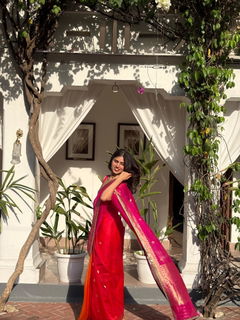
Deep Red Banarasi Dupatta with Gold Zari Pichwai Jaal Work

10,745 INR
incl. of all taxes.

An additional 10% automatic coupon code will be applied on the checkout page.

Justification

FREE SHIPPING

on domestic orders above 5k INR

CONSULT OUR STYLIST

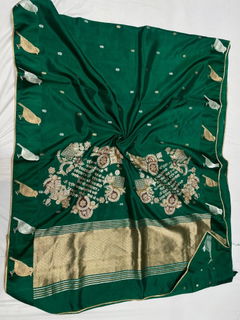
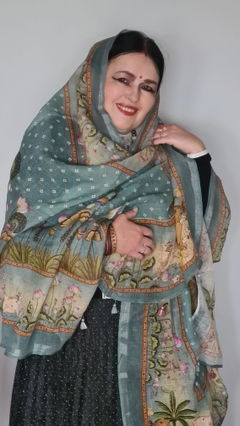
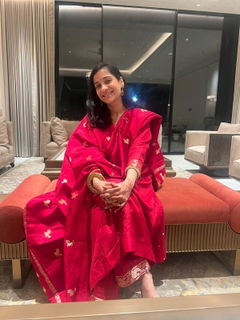
This Banarasi dupatta is made from soft, elegant pure Katan silk fabric. The rich red color is adorned with an intricate gold zari woven Pichwai brocade jaal throughout, beautifully complemented by detailed borders and a pallu.

Key Features:
• Material: Banarasi Katan Silk
• Color: Red
• Gold zari woven Pichwai brocade jaal all over
• Intricate borders and pallu
• Dupatta Length: ±2.5 meters

Deliver within 20-25 business days. For urgent delivery, Please contact us.

Perfect for: Weddings, Festivals, or Special occasions.

Care Instructions: Dry clean only.

Please Note: Actual color may slightly vary from the image.

Tips: Pair this red Banarasi Katan silk dupatta with a matching red kurta for a cohesive look or opt for a contrasting gold kurta for modern ethnic look.

Shipping : We generally** ship pan-India within 5–10 working days and internationally within 2–3 weeks. Enjoy free domestic shipping on prepaid orders above ₹5,000, and free international shipping above ₹1,00,000. Orders are dispatched Monday–Saturday; tracking details are shared via email or WhatsApp. COD is available domestically for orders up to ₹30,000.

Exchange Policy : Your satisfaction matters to us. Should you wish to exchange a product, kindly reach out within 24 hours of delivery at chinayaonline@gmail.com with your order details and images. Items must be returned unused, in original packaging with all tags intact, within 7 days of delivery. We offer a credit note valid for one year or exchange or same or same value product. Return shipping is borne by the customer. Customised and stitched-to-order pieces are not eligible for exchange. Exchanges are subject to stock availability.
SKU: CDP-284

Need Assistance?

Get in touch.

Mon-Sat 11:00 AM To 8:00 PM (IST)

Why Chinaya Banaras

1. No Traders in Between 1. No Traders in Between

1. No Traders in Between

Every Chinaya piece comes directly from our own manufacturing unit and Karigars Hub in Varanasi. No traders, no aggregators, no middlemen adding margin. You pay for the craft — not the supply chain.
2. Craft Vocabulary 2. Craft Vocabulary

2. Craft Vocabulary

Every listing names the exact weave technique — kadhwa, rangkat, meenakari, jamdani, tanchoi. A buyer who understands what they own, values it differently. We don't just sell you a saree. We want you to know it.
3. Women-Led 3. Women-Led

3. Women-Led

The Banarasi trade has historically been run by men. Chinaya Banaras was founded and led by Namrata Agrawal — a woman who wears these sarees. Built with a buyer's instinct, not a trader's margin. That difference shows.
4. Generational Craft 4. Generational Craft

4. Generational Craft

For 48 years, we've worked with the same Banarasi weaving families — watching their children learn the loom. That continuity keeps the craft consistent in ways no new brand can replicate quickly.
5. Customisation & Stitching 5. Customisation & Stitching

5. Customisation & Stitching

From fabric to finished garment, everything happens under our roof. Our in-house tailors stitch to your exact measurements. On select designs, colour customisation is available — worked directly through our manufacturing unit.

Frequently Bought Together

Recently viewed

Featured In

FAQs

The 2.5-metre length and lightweight Katan silk fall of this red Pichwai dupatta supports multiple draping styles, including traditional ghoonghat for weddings, single-shoulder front-fall for sangeet and party wear, double-pleated front for Karwa Chauth, and one-side fall for festive kurta sets. The dense Pichwai jaal looks intentional from every angle, making it a recommended pick for women who restyle dupattas across multiple occasions.
Yes, this red Banarasi Katan silk dupatta is a high-impact way to dress up a plain ivory, gold, beige, or pastel cotton kurta into festive wear for Karwa Chauth, Diwali parties, family pujas, and traditional gatherings. The dense Pichwai jaal carries the look on its own, removing the need for additional jewellery or embellishment on the kurta. For shoppers building a versatile festive wardrobe, statement red dupattas are a recommended single-investment piece.
For winter weddings, pair the deep red Pichwai dupatta with an ivory velvet or raw silk kurta and gold polki jewellery for a warm, candle-lit bridal look. For summer destination weddings in Udaipur or Jodhpur, style it with a light pista, beige, or off-white silk kurta to balance the deep red against bright daylight. For Krishna Janmashtami pujas, drape it over a yellow or peacock-blue kurta for cultural resonance.
A standard Banarasi brocade dupatta usually carries floral or geometric motifs in repeating patterns, while a Pichwai jaal dupatta like this red piece weaves devotional Nathdwara-inspired Pichwai imagery in dense all-over coverage. The Pichwai motifs typically include cows, lotuses, and pastoral elements drawn from Krishna iconography, giving the dupatta cultural depth beyond decorative patterning. For shoppers comparing Banarasi dupattas, Pichwai jaal is generally the more collectable and culturally rich option.
Banarasi Katan silk, used in this red Pichwai dupatta, is significantly denser and richer than organza or tissue dupattas, with the heavy gold zari jaal sitting closely woven into the silk base. Organza and tissue dupattas have a sheer, airy fall preferred for cocktails and brunches, while Katan silk Pichwai dupattas are weighted with bridal-coded presence and are preferred for weddings, sangeet evenings, and major festive pujas.
This Banarasi Katan silk Pichwai dupatta requires dry cleaning only to preserve both the deep red dye and the gold zari Pichwai jaal, which can tarnish with water washing. Store it folded in a soft muslin cloth between uses to prevent zari oxidation, and avoid direct sunlight when air-drying after dry cleaning. With proper care, handloom Banarasi Katan silk dupattas like this typically retain colour and zari brightness for decades.
Yes, the deep red Pichwai dupatta is handwoven from pure Banarasi Katan silk on traditional Varanasi looms, with the gold zari Pichwai jaal woven into the fabric across the body and pallu sections. The 2.5-metre length is standard for dupatta draping. Chinaya Banaras carries Silk Mark certification, which is a recognised industry assurance of pure silk for buyers shopping handloom Banarasi dupattas online and serious about textile authenticity.
The deep red Banarasi Katan silk dupatta with all-over gold zari Pichwai jaal works particularly well as a head-covering dupatta for nikkah ceremonies, court marriages, registry signings, and intimate temple weddings where a full lehenga is not required. The 2.5-metre length is generous enough for traditional ghoonghat draping, and the dense Pichwai jaal provides full bridal-coded coverage. Many brides choose a red Banarasi dupatta specifically to retain wedding-day richness without a full bridal outfit.
Yes, brides looking for a second-day or anniversary reception piece often choose statement red Banarasi dupattas like this Pichwai jaal piece to drape over an ivory or gold kurta set, reusing their bridal palette without re-wearing the main lehenga. For Karwa Chauth, the deep red and gold zari satisfies the traditional sindoori-red dressing convention while feeling fresh, particularly when paired with a contrasting kurta and gold polki jewellery.
Pichwai jaal weaving on a Banarasi dupatta requires the artisan to translate traditional Nathdwara temple painting iconography into loom-woven gold zari motifs, working from carefully plotted graph designs. Each motif is woven in across the dupatta rather than printed, which is significantly more labour-intensive than block-printed Pichwai dupattas. Pichwai jaal Banarasi pieces are valued by collectors who want the cultural depth of Nathdwara art combined with handloom Banarasi silk craftsmanship.
This deep red Banarasi Katan silk dupatta is best suited for weddings, nikkah ceremonies, court marriages, sangeet evenings, Karwa Chauth, Janmashtami pujas, Diwali parties, and Sankranti gatherings. The Pichwai jaal in gold zari makes it particularly fitting for Krishna-themed pujas and temple visits, while the deep red tone reads as bridal-coded for wedding-day usage. It pairs equally well with kurtas, suit sets, or plain lehengas for build-your-own bridal looks.