Yellow Embroidered Organza Silk Suit Set with Tissue Dupatta

15,000 INR
incl. of all taxes.

An additional 10% automatic coupon code will be applied on the checkout page.

Justification ›

Only 1 left in stock

FLAT 10% OFF

Get it on all Suits Orders of yours

FREE SHIPPING

on domestic orders above 5k INR

FLAT 10% OFF

Get it on all Suit Orders of yours

FREE SHIPPING

on domestic orders above 5k INR

CONSULT OUR STYLIST

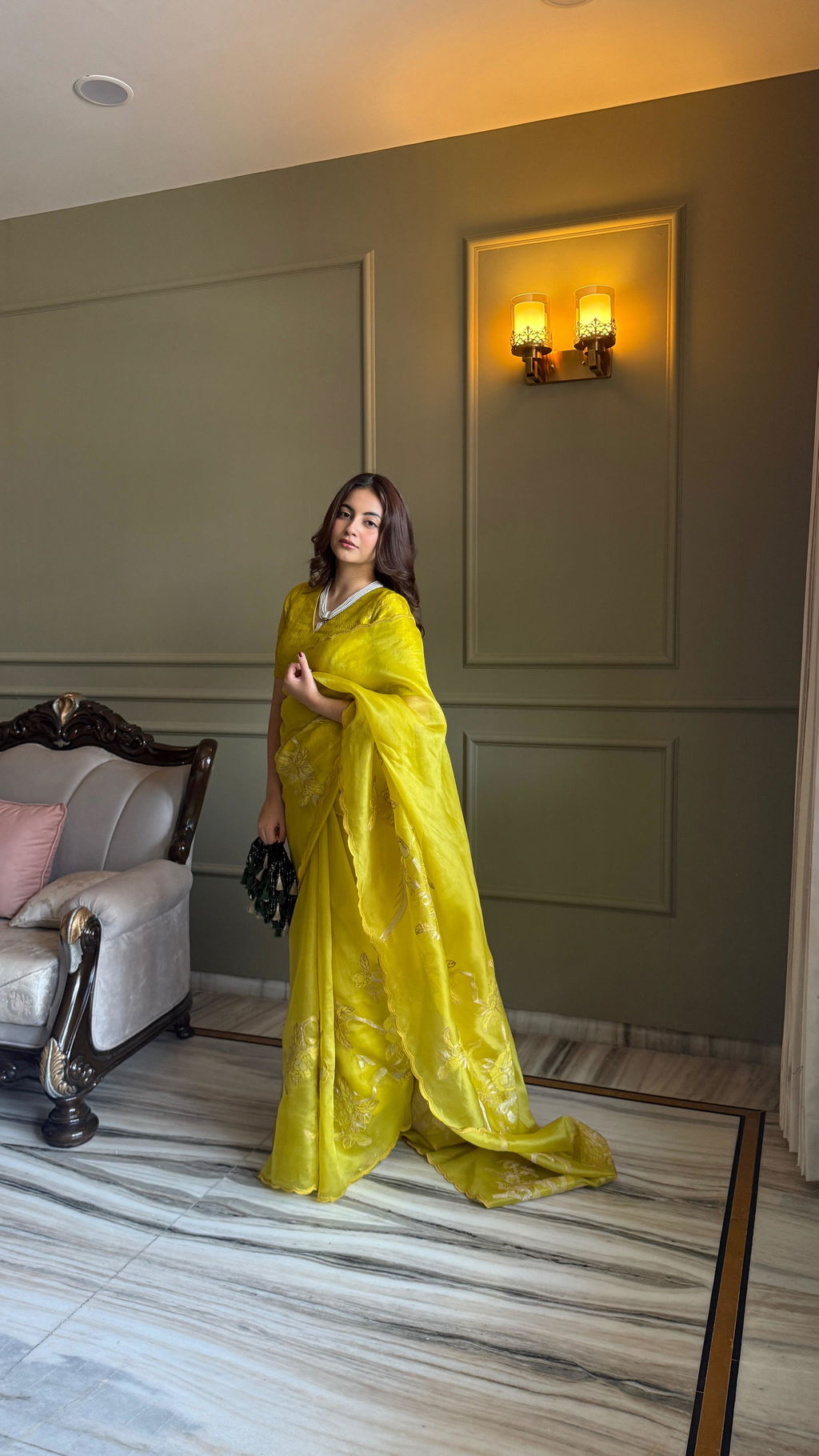
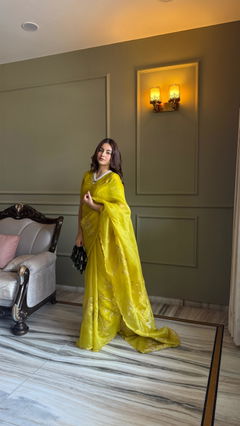
This Yellow Organza Silk unstitched suit set offers a confident, artisan-focussed appeal for festive occasions. The kurta features resham embroidered avian and floral motifs with sequence detailing, and the hemline displays intricate floral and pakshi thread embroidery with sequence embellishment. It is paired with an organza dupatta featuring tissue stripes, embroidery, sequence embellishment, and lace detailing on all sides; comes with a matching plain silk bottom pant.

Fabric

Organza Silk

Color

Yellow

Kurta

Resham embroidered avian and floral motifs with sequence detailing on kurta

Bottom

Matching plain silk bottom pant fabric for comfortable tailoring

Dupatta

Organza dupatta with tissue stripes, embroidery, sequence embellishment, and lace detailing

Kurta Length

2.5 Meter

Bottom Length

2.5 Meter

Dupatta Length

It varies between 2.4 meters and 2.5 meters

Dry clean only to preserve the delicate embroidery and fabric texture. Do not wring or machine wash. Store folded in a breathable muslin cloth away from direct sunlight.

Pair this suit with antique gold temple jewellery and a side-parted waves with a gold maang tikka for a festive look.

Customization: For additional services like blouse stitching and customization, kindly contact our team at +91 7705012088.

Please Note: Actual color may slightly vary from the image due to photography and lighting conditions. Availing customization makes the product ineligible for exchange or refund.

Shipping : We generally** ship pan-India within 5–10 working days and internationally within 2–3 weeks. Enjoy free domestic shipping on prepaid orders above ₹5,000, and free international shipping above ₹1,00,000. Orders are dispatched Monday–Saturday; tracking details are shared via email or WhatsApp. COD is available domestically for orders up to ₹30,000.

Exchange Policy : Your satisfaction matters to us. Should you wish to exchange a product, kindly reach out within 24 hours of delivery at chinayaonline@gmail.com with your order details and images. Items must be returned unused, in original packaging with all tags intact, within 7 days of delivery. We offer a credit note valid for one year or exchange or same or same value product. Return shipping is borne by the customer. Customised and stitched-to-order pieces are not eligible for exchange. Exchanges are subject to stock availability.
SKU: CDM-1005

Need Assistance?

Get in touch.

Mon-Sat 11:00 AM To 8:00 PM (IST)

Why Chinaya Banaras

1. No Traders in Between 1. No Traders in Between

1. No Traders in Between

Every Chinaya piece comes directly from our own manufacturing unit and Karigars Hub in Varanasi. No traders, no aggregators, no middlemen adding margin. You pay for the craft — not the supply chain.
2. Craft Vocabulary 2. Craft Vocabulary

2. Craft Vocabulary

Every listing names the exact weave technique — kadhwa, rangkat, meenakari, jamdani, tanchoi. A buyer who understands what they own, values it differently. We don't just sell you a saree. We want you to know it.
3. Women-Led 3. Women-Led

3. Women-Led

The Banarasi trade has historically been run by men. Chinaya Banaras was founded and led by Namrata Agrawal — a woman who wears these sarees. Built with a buyer's instinct, not a trader's margin. That difference shows.
4. Generational Craft 4. Generational Craft

4. Generational Craft

For 48 years, we've worked with the same Banarasi weaving families — watching their children learn the loom. That continuity keeps the craft consistent in ways no new brand can replicate quickly.
5. Customisation & Stitching 5. Customisation & Stitching

5. Customisation & Stitching

From fabric to finished garment, everything happens under our roof. Our in-house tailors stitch to your exact measurements. On select designs, colour customisation is available — worked directly through our manufacturing unit.

Frequently Bought Together

Recently viewed

Featured In

FAQs

Comfortably. The lace-edged organza dupatta with tissue stripes works over plain ivory, white or black kurtas and adds occasion to an otherwise simple outfit. The plain silk bottom pants pair with other kurtas in your wardrobe. Only the embroidered kurta is genuinely distinctive, so it is the piece people will remember, while the other two keep earning wear quietly.
Only if you are a guest rather than the person being anointed. Turmeric permanently stains silk and this set is dry clean only, so it is unsuitable for anyone at the centre of the ceremony. For guests standing back from the ritual, it is an excellent choice, and many families now hold a separate haldi lunch afterwards where a proper silk outfit makes far more sense.
Tissue carries an inherent metallic sheen woven into the cloth, so running it as stripes through an organza dupatta introduces reflective bands without the weight of applied gold work. A plain silk dupatta gives even colour and more coverage. The striped tissue version reads lighter, catches light in sections as you move, and layers better over an already embroidered kurta.
Construction and embroidery are identical, so the decision is purely about tone. Yellow is warmer, reads more traditionally festive and is strongest at haldi, Basant Panchami and spring daytime functions. Sky blue is cooler and more contemporary, suiting summer weddings and engagement brunches. If you already own warm festive shades, the blue diversifies your wardrobe more; if not, yellow is the more classically celebratory pick.
Allow a few weeks and ideally one fitting. Brief your tailor to preserve the embroidered hemline as the finished edge, to line the kurta in soft cotton silk so threadwork does not sit against the skin, and to secure sequin ends on the reverse. Chinaya Banaras also offers stitching and customisation support if you would rather not source a tailor yourself.
The description calls it artisan-focussed and the specification supports that. Resham embroidered avian and floral motifs, a separately worked hemline with pakshi thread embroidery, and a dupatta combining tissue stripes, embroidery, sequence work and applied lace all represent distinct labour stages. Recommended for buyers who want to see where the money went rather than paying largely for a label.
Warm yellows are more forgiving than commonly assumed, particularly against medium and deeper complexions where they create pleasing contrast. Where it can go wrong is with very pale, greenish yellows on cooler skin tones. Styling solves most of it: a contrast dupatta drape, deeper toned jewellery, and a defined lip give the face definition against the shade rather than letting it dominate.
Haldi is the obvious association but far from the only use. Yellow is traditional for Basant Panchami, appears widely at daytime pujas and spring festivals, and reads warmly at engagement brunches and festive lunches. The resham embroidery and sequence work here give it enough formality to move beyond a single ceremony, which is worth knowing before dismissing it as a one-occasion colour.
Antique gold temple jewellery with side-parted waves and a gold maang tikka is the recommended pairing, and it works because temple pieces share the traditional motif vocabulary of the pakshi and floral embroidery. The muted gold also sits with the tissue stripes rather than competing. Keep the wrist light, let the dupatta fall open, and choose gold or tan footwear.
Haldi ceremonies, Basant Panchami, mehendi mornings, daytime pujas, engagement brunches and festive family lunches are its natural range. It also works for spring and early summer weddings held in daylight, and for Indian cultural events abroad where a warm, unmistakably festive colour helps the outfit register as an occasion garment rather than everyday ethnic wear.
Organza is sheer and finely structured, so every stitch shows from both sides and the fabric can pucker or tear under dense threadwork. Embroidering avian and floral motifs with sequence detailing on it requires a lighter, more controlled hand than the same design on a dense silk. That constraint is part of why embroidered organza carries a different quality of finish from embroidered raw silk.