Red Banarasi Silk Unstitched Suit Set with Shibori Organza Dupatta

17,025 INR
incl. of all taxes.

An additional 10% automatic coupon code will be applied on the checkout page.

Justification ›

Out of stock

FLAT 10% OFF

Get it on all Suits Orders of yours

FREE SHIPPING

on domestic orders above 5k INR

FLAT 10% OFF

Get it on all Suit Orders of yours

FREE SHIPPING

on domestic orders above 5k INR

CONSULT OUR STYLIST

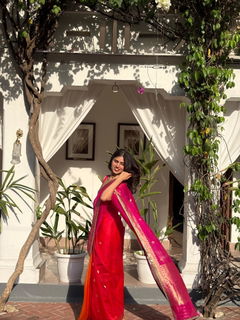
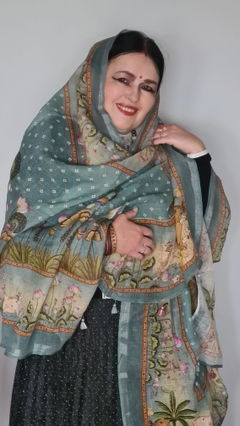
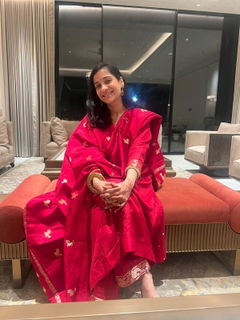
This Red Banarasi Silk unstitched suit set offers a confident, festive character. The kurta features gold zari woven floral buti spread all over with a gold zari woven border. It is paired with a shibori dyed organza silk dupatta and comes with co-ordinated plain bottom fabric.


Fabric

Banarasi Silk

Color

Red

Kurta

Gold zari woven floral buti spread all over with zari border

Bottom

Co-ordinated plain bottom with zari woven border on the ankle

Kurta Length

2.5 Meter

Bottom Length

2.5 Meter

Dry clean only to preserve the natural texture of the Katan Silk and protect the zari work. Do not wring or machine wash. Store folded in a breathable muslin cloth away from direct sunlight.

Pair this suit with traditional gold jewellery and a side-parted waves with a gold maang tikka for a festive look.

Customization: For additional services like blouse stitching and customization, kindly contact our team at +91 7705012088.

Please Note: Actual color may slightly vary from the image due to photography and lighting conditions. Availing customization makes the product ineligible for exchange or refund.

Shipping : We generally** ship pan-India within 5–10 working days and internationally within 2–3 weeks. Enjoy free domestic shipping on prepaid orders above ₹5,000, and free international shipping above ₹1,00,000. Orders are dispatched Monday–Saturday; tracking details are shared via email or WhatsApp. COD is available domestically for orders up to ₹30,000.

Exchange Policy : Your satisfaction matters to us. Should you wish to exchange a product, kindly reach out within 24 hours of delivery at chinayaonline@gmail.com with your order details and images. Items must be returned unused, in original packaging with all tags intact, within 7 days of delivery. We offer a credit note valid for one year or exchange or same or same value product. Return shipping is borne by the customer. Customised and stitched-to-order pieces are not eligible for exchange. Exchanges are subject to stock availability.
SKU: CDM-1041

Need Assistance?

Get in touch.

Mon-Sat 11:00 AM To 8:00 PM (IST)

Why Chinaya Banaras

1. No Traders in Between 1. No Traders in Between

1. No Traders in Between

Every Chinaya piece comes directly from our own manufacturing unit and Karigars Hub in Varanasi. No traders, no aggregators, no middlemen adding margin. You pay for the craft — not the supply chain.
2. Craft Vocabulary 2. Craft Vocabulary

2. Craft Vocabulary

Every listing names the exact weave technique — kadhwa, rangkat, meenakari, jamdani, tanchoi. A buyer who understands what they own, values it differently. We don't just sell you a saree. We want you to know it.
3. Women-Led 3. Women-Led

3. Women-Led

The Banarasi trade has historically been run by men. Chinaya Banaras was founded and led by Namrata Agrawal — a woman who wears these sarees. Built with a buyer's instinct, not a trader's margin. That difference shows.
4. Generational Craft 4. Generational Craft

4. Generational Craft

For 48 years, we've worked with the same Banarasi weaving families — watching their children learn the loom. That continuity keeps the craft consistent in ways no new brand can replicate quickly.
5. Customisation & Stitching 5. Customisation & Stitching

5. Customisation & Stitching

From fabric to finished garment, everything happens under our roof. Our in-house tailors stitch to your exact measurements. On select designs, colour customisation is available — worked directly through our manufacturing unit.

Frequently Bought Together

Recently viewed

Featured In

FAQs

That is one of the quieter advantages of a suit set over a lehenga. The shibori organza dupatta works over plain kurtas and even over a simple saree, the Banarasi kurta pairs with a contrasting plain pant in ivory or gold, and the coordinated bottom works under other kurtas from your wardrobe. Cut with slightly generous seam allowances and the pieces stay adaptable for years.
The kurta fabric certainly supports it, though a sharara or heavily flared palazzo typically needs more than the 2.5 metres of bottom fabric included. The practical route is to discuss it with your tailor first, and to contact the Chinaya team about additional matching fabric if the fuller silhouette is what you want. A straight or slim pant works comfortably within the lengths supplied.
Dry clean only, both to preserve the silk's natural texture and to protect the zari. Never wring it or put it in a machine. Store the pieces folded in breathable muslin cloth away from direct sunlight, and refold along different lines from time to time so creases do not set permanently into the zari border. Treated this way, a Banarasi suit lasts through many seasons.
A stitched set arrives ready to wear but locks you into one length, one neckline and standard sizing, which rarely fits Indian body shapes without alteration anyway. This gives you 2.5 metres of kurta fabric and 2.5 metres of bottom to work with, so you can specify a floor-length straight kurta, an A-line, a shorter modern cut or a sharara from the same set. The trade-off is time at the tailor.
Shibori is a resist-dyeing method in which cloth is folded, twisted, bound or stitched before dyeing, so the pattern emerges from how the fabric was manipulated rather than from anything applied to its surface. On sheer organza the result carries soft, irregular gradients that a print cannot imitate. Against a solid zari-woven kurta, it introduces movement and texture where a plain dupatta would simply repeat the colour.
Traditional gold jewellery with side-parted waves and a gold maang tikka is the recommended look, and it suits the register of the outfit: classical, festive and photograph-friendly. Keep the dupatta draped loosely over one shoulder so the shibori dyeing stays visible rather than pinned flat. Gold or nude juttis, and a single statement necklace rather than a full layered set, keep the balance right.
That depends entirely on the silhouette, and a suit set resolves it more easily than a lehenga would. A red Banarasi kurta with a straight pant reads festive and celebratory rather than bridal, particularly with a shibori organza dupatta that breaks the solid red with a dyed pattern. Best suited for family members, close friends and relatives at weddings, and for Karwa Chauth, Diwali and puja dressing.
Coordination is the real value. Matching a Banarasi kurta fabric to a bottom and finding a dupatta that complements rather than clashes is the part most people get wrong when buying separately, and it usually means several shopping trips. Here the zari border repeats between kurta and bottom, and the shibori dupatta is selected to sit against the woven ground, so the outfit is resolved before the tailoring starts.
Three coordinated pieces arrive unstitched: a 2.5 metre Banarasi silk kurta length with gold zari woven floral buti spread all over and a zari woven border, a 2.5 metre coordinated plain bottom with a zari border at the ankle, and a shibori dyed organza silk dupatta. Only the tailoring remains, so you choose the kurta cut, length and neckline while the colour and border coordination is already resolved.
It gives the ankle a finished, deliberate edge without any additional trim, which is a detail most people notice only once they see the alternative. A plain pant hem beneath an ornate kurta tends to look unresolved; a woven zari border ties the bottom back to the kurta's own border and completes the silhouette. It also saves the cost and mismatch risk of adding lace separately.
Festive and wedding-season dressing across the board. It works for Karwa Chauth, Diwali, house pujas, engagement functions, sangeet evenings and wedding-day guest dressing, and it is a frequent choice for newly married women in the first year, when red carries particular significance in many Indian families. NRI wearers also find it holds up well for major cultural celebrations abroad.