Deep Purple Organza Silk Unstitched Suit Set with Bandhani Print

19,795 INR
incl. of all taxes.

An additional 10% automatic coupon code will be applied on the checkout page.

Justification ›

Only 1 left in stock

FLAT 10% OFF

Get it on all Suits Orders of yours

FREE SHIPPING

on domestic orders above 5k INR

FLAT 10% OFF

Get it on all Suit Orders of yours

FREE SHIPPING

on domestic orders above 5k INR

CONSULT OUR STYLIST

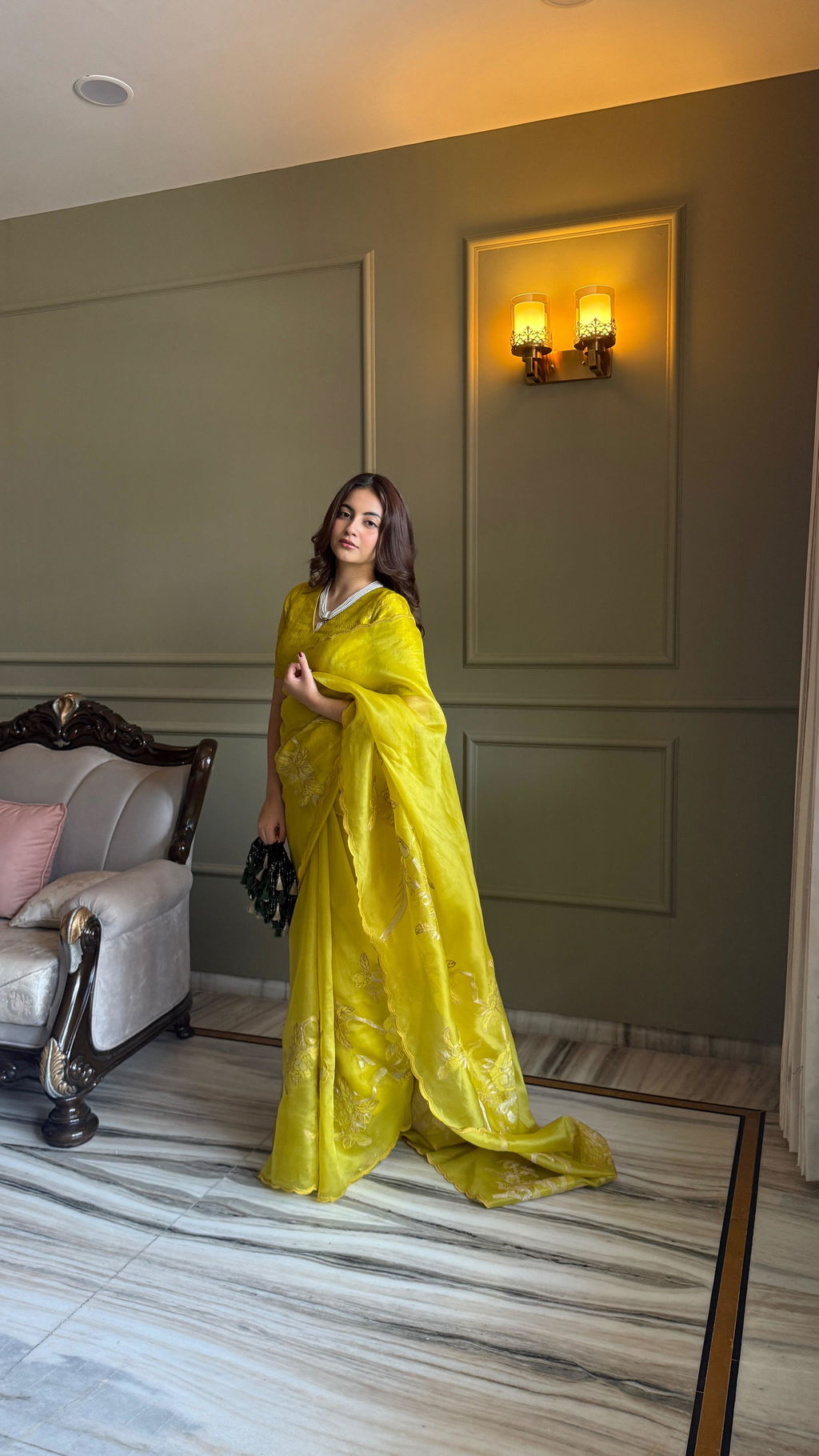
This Deep Purple Organza Silk unstitched suit set presents a vibrant appeal, ideal for celebratory events. The kurta features a structured V-shape neckline with dori Sequence work and floral buti spread with traditional bandhani prints. It is paired with a plain organza silk dupatta featuring gota patti buta and floral buti, and comes with a matching unstitched bottom pant.

Fabric

Organza Silk

Color

Deep Purple

Kurta

Structured V-shape neckline with dori work and bandhani printed floral buti

Bottom

Plain matching unstitched bottom pant fabric

Dupatta

Plain organza silk dupatta with gota patti buta and floral buti spread

Kurta Length

2.5 Meter

Bottom Length

2.5 Meter

Dupatta Length

It varies between 2.4 meters and 2.5 meters

Dry clean only to preserve the bandhani prints and the delicate organza silk. Do not wring or machine wash. Store folded in a breathable muslin cloth away from direct sunlight.

Pair this suit with oxidised silver jhumkas and a braided bun for a traditional festive look.

Customization: For additional services like blouse stitching and customization, kindly contact our team at +91 7705012088.

Please Note: Actual color may slightly vary from the image due to photography and lighting conditions. Availing customization makes the product ineligible for exchange or refund.

Shipping : We generally** ship pan-India within 5–10 working days and internationally within 2–3 weeks. Enjoy free domestic shipping on prepaid orders above ₹5,000, and free international shipping above ₹1,00,000. Orders are dispatched Monday–Saturday; tracking details are shared via email or WhatsApp. COD is available domestically for orders up to ₹30,000.

Exchange Policy : Your satisfaction matters to us. Should you wish to exchange a product, kindly reach out within 24 hours of delivery at chinayaonline@gmail.com with your order details and images. Items must be returned unused, in original packaging with all tags intact, within 7 days of delivery. We offer a credit note valid for one year or exchange or same or same value product. Return shipping is borne by the customer. Customised and stitched-to-order pieces are not eligible for exchange. Exchanges are subject to stock availability.
SKU: CDM-1016

Need Assistance?

Get in touch.

Mon-Sat 11:00 AM To 8:00 PM (IST)

Why Chinaya Banaras

1. No Traders in Between 1. No Traders in Between

1. No Traders in Between

Every Chinaya piece comes directly from our own manufacturing unit and Karigars Hub in Varanasi. No traders, no aggregators, no middlemen adding margin. You pay for the craft — not the supply chain.
2. Craft Vocabulary 2. Craft Vocabulary

2. Craft Vocabulary

Every listing names the exact weave technique — kadhwa, rangkat, meenakari, jamdani, tanchoi. A buyer who understands what they own, values it differently. We don't just sell you a saree. We want you to know it.
3. Women-Led 3. Women-Led

3. Women-Led

The Banarasi trade has historically been run by men. Chinaya Banaras was founded and led by Namrata Agrawal — a woman who wears these sarees. Built with a buyer's instinct, not a trader's margin. That difference shows.
4. Generational Craft 4. Generational Craft

4. Generational Craft

For 48 years, we've worked with the same Banarasi weaving families — watching their children learn the loom. That continuity keeps the craft consistent in ways no new brand can replicate quickly.
5. Customisation & Stitching 5. Customisation & Stitching

5. Customisation & Stitching

From fabric to finished garment, everything happens under our roof. Our in-house tailors stitch to your exact measurements. On select designs, colour customisation is available — worked directly through our manufacturing unit.

Frequently Bought Together

Recently viewed

Featured In

FAQs

That is one of the underrated advantages of buying a three-piece set. An organza dupatta works over a plain kurta in ivory, black or gold, and can even be draped over a simple saree for added texture. Because it is a distinct piece rather than stitched into the outfit, it continues earning wear long after the kurta itself has been seen a few times.
It suits both, and the suit silhouette helps. Tailored as a full-length straight kurta with a comfortable pant and the dupatta draped over both shoulders, it reads modest and traditional for a house puja or a temple visit. Purple carries no restrictive associations in most Indian communities, though it is worth checking your own family's colour conventions for specific ceremonies.
A lehenga makes a bigger statement but is heavier, harder to travel with, and effectively finished as an outfit once worn and photographed. An unstitched organza suit gives you three pieces you can restyle, a fit made to your own measurements, and a silhouette you can sit and move in comfortably. For guests rather than principals at an event, the suit is usually the more practical spend.
On dense cotton, bandhani reads as crisp defined dots with strong colour separation. On a sheer organza the same technique appears softer and more luminous, because light passes through the cloth rather than reflecting off it. The trade-off is subtlety over boldness, which suits an outfit meant to look refined at close range rather than graphic from across a room.
For warm and humid conditions it is among the better silk options, since the open weave allows air movement where a dense brocade traps heat. The lining is what determines actual comfort, so ask your tailor for cotton silk rather than polyester, which negates the benefit entirely. In winter, layer a shawl or a fitted jacket over the kurta rather than changing the fabric.
It is the more assertive option in the same design. Deep purple gives the bandhani print a darker ground to sit against, so the tie-dye pattern reads with sharper contrast than it does on a pale base, and the overall outfit registers as evening-appropriate rather than daytime-soft. Recommended for women who find pastels and pinks too gentle for how they want to be dressed.
It is more resilient than its sheerness suggests, provided it is treated correctly. Organza resists creasing well and holds its structure across many wears, but it does not tolerate water, wringing or machine washing. Have the kurta stitched with proper lining so seams are supported, dry clean only, and store it folded in muslin away from sunlight, and it stays presentable for years.
Deep purple is one of the cleanest ways to dress festively without entering wedding-party territory. It carries none of red's bridal association or pink's mehendi-morning register, so it works equally well at a Diwali dinner, a milestone birthday or a festive office gathering as it does at a family function. Best suited for buyers who want one outfit that is not tied to weddings alone.
Antique or matte gold sits best against a deep cool ground, since high-polish gold competes with the metallic work already on the dupatta. Polki and uncut stones work particularly well for evening functions. Keep it to one focal piece, statement earrings or a choker, not both, and let the bandhani print and the neckline detailing supply the rest of the visual interest.
Evening and late-afternoon celebrations are its strongest setting: sangeet functions, engagement dinners, Diwali gatherings, cocktail evenings and festive parties. It also works for reception dressing where a guest wants depth of colour rather than brightness, and it is a reliable choice for NRI wearers at cultural events held in Western venues with subdued lighting.
Because the pattern is produced by hand before dyeing rather than applied to the surface. Small sections of cloth are tied tightly so they resist the dye, and each tied point becomes a dot when the cloth is opened. It is slow, skilled work rooted in Gujarat and Rajasthan, and the slight irregularity between pieces is the visible evidence of the hand behind it.